


- Public universities in Germany charge no tuition fees; only a semester contribution of €100 to €350 (₹10,700 to ₹37,450) applies depending on the state and institution.
- The blocked account requirement for Germany is €992 per month and €11,904 per year (₹12.7L) for international students.
- Total monthly living costs at public universities in Germany range from €890 to €1,490 (₹95,230 to ₹1.6L) covering accommodation, food, travel, health insurance, and more.
- Reasons to Choose Public Universities in Germany
- Top Public Universities In Germany
- Difference between Public vs Private Universities in Germany
- How Do I Apply To Study at Public Universities in Germany?
- Post-Study Work Visa in Germany
- Cost of Studying in Public Universities in Germany
- Cost of Living
- Key Takeaways
- FAQs

Students pursue a Master’s in Germany due to the low tuition fees in public universities and high-quality education. In this blog you will get to know about various public universities in germany along with the specialisation they offer and the scholarships for Indian students.
Reasons to Choose Public Universities in Germany
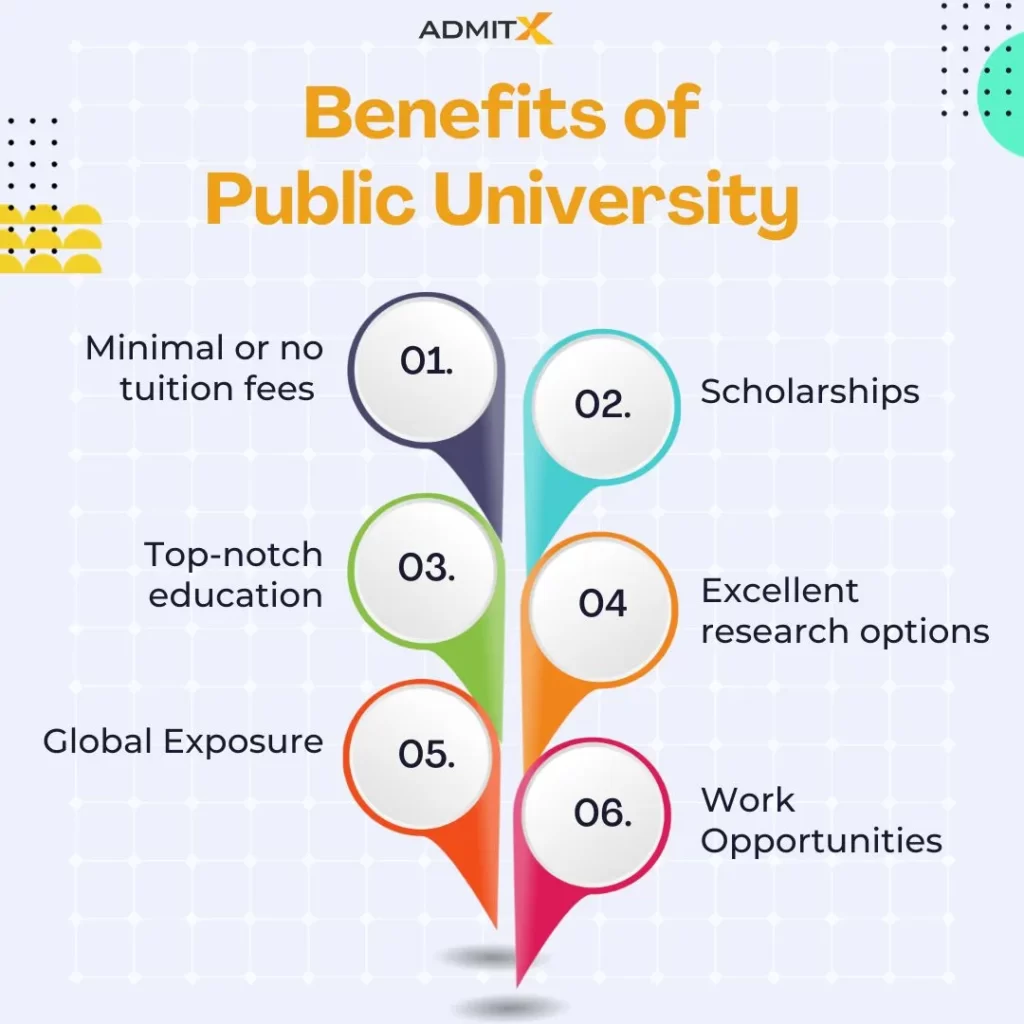
Minimal or No Tuition Fees: One of the most significant advantages of studying at a public university in Germany is the lack of tuition fees for both undergraduate and graduate programs. While there is a small semester contribution of approximately €100 to €350 per semester depending on the state and university, covering student union membership, public transport, and administrative costs.
Generous Scholarship Opportunities: Even though tuition fees are minimal, German universities offer a variety of scholarships to help international students further reduce their educational expenses. These scholarships can cover living costs, tuition fees, or a combination.
World-Class Education: German universities are renowned globally for their high-quality education and excellent infrastructure. They offer a wide range of programs across various academic disciplines, and their graduates are highly sought after by employers worldwide.
Excellent Research Facilities: German universities provide state-of-the-art research facilities, allowing students to engage in cutting-edge research under the guidance of renowned experts. This hands-on experience can be invaluable for career advancement.
Global Exposure: German universities have a diverse international student population, allowing students to interact with people from different cultures and backgrounds. This fosters intercultural understanding and broadens students’ perspectives.
Post-Study Work Opportunities: After graduating from a German university, international students who graduate from a German university can apply for an 18-month Job Seeker Visa (Aufenthaltserlaubnis zur Arbeitssuche) to find employment related to their qualification.
Top Public Universities In Germany
Here is the list of universities along with the specialisation and scholarships for Indian students in Germany:
| University | Popular Courses | Scholarships |
|---|---|---|
| Technical University of Munich | MSc. in Aerospace Engineering MSc. in Automotive Engineering MSc in Chemical Engineering MSc. in Data Engineering and Analytics MSc. in Computer Science MSc. Mechanical Engineering | TUM talent scholarships Deutschlandstipendium DAAD scholarship |
| Humboldt University of Berlin | MSc. Computer Science Master of Arts in International Relations Master of Business Administration (MBA) MSc. Information Systems MSc. Biophysic | Deutscher Akademischer Austauschdienst (DAAD) Stipendiumplus (Begabtenförderung im Hochschulbereich) myStipendium |
| Ludwig Maximilian University | MA in International Relations MSc. Psychology Master of Business Administration MSc. Data Science | Assistance in the case of Financial Stability SIST LMU Study Scholarship Funding for Female Students Oskar Karl Forster Scholarship |
| RWTH Aachen University | MSc in Data Science MSc. Civil Engineering MSc. International Management MSc. Management & Engineering in Computer-Aided Mechanical Engineering | High Potential Student Grant Women in Engineering Scholarship Qualification Programs: Outstanding Performance Award |
| Technical University of Berlin | Master of Building Sustainability MSc. in Building Archeology and Heritage Conservation MSc. in Aeronautics and Astronautics MSc. in Automotive Systems MSc. in Audio Communication and Technology | TU Berlin President’s Scholarship |
| University of Stuttgart | MSc. in Electrical Engineering MSc. Computer Science MSc. Computational Linguistics MSc. Information Technology (INFOTECH) | DAAD STIBET Beihilf |
| Technical University of Braunschweig | MSc. Advanced Computer Architecture MSc. Advanced Topics in Automotive Systems Engineering MSc. Advanced Topics in Communication Theory MSc. Advanced Quantum Technologies for Engineers | Deutschlandstipendium |
| Karlsruhe Institute of Technology | MSc. in Electrical Engineering and Information Technology MSc. in Mechanical Engineering Master of Science MSc. in Materials Science and Engineering MSc. in Mechatronics and Information Technology M.Sc. in Bioengineering | DAAD Scholarship Baden-Württemberg-Scholarship |
| Technical University of Dresden | MSc. Computational Logic MSc. Computational Modeling and Simulation MSc. Distributed Systems Engineering MSc. in Nanoelectronic Systems | DAAD, Deutschlandstipendium |
| University of Bonn | MSc. in Computer Science Master’s in Cyber Security MSc. in Geodetic Engineering | Deutschlandstipendium Ließem scholarship |
Difference between Public vs Private Universities in Germany
While private institutions may provide more specialised or flexible alternatives but at a higher cost, public universities are noted for their accessibility and robust academic offerings. It’s essential to conduct thorough research on particular colleges and programs to identify the one that best suits your goals for education and employment.
| Key Differences | Public Universities | Private Universities |
|---|---|---|
| Tuition Fees | €100–350 per semester (semester contribution only) | €10,000–€30,000 per year |
| Admission Requirements | Highly competitive; attracts thousands of applicants | Relatively straightforward; flexible minimum requirements |
| Programmes | Wide range of academic programmes across all disciplines | Fewer options than public universities; more specialised courses |
| Intakes | Winter and summer intake | Rolling deadlines for most courses |
| University Rankings | Globally recognised; strong QS World University Rankings presence | Less global recognition than public universities |
How Do I Apply To Study at Public Universities in Germany?
The application process for the best public universities in Germany universities involves three primary steps:
Step 1: Apply to Your Desired University
To begin your application, you have a few options:
- Apply directly through the university’s official website: This is the most common method.
- Use the centralised admissions portal for international students, run by the German Academic Exchange Service (DAAD): While not all universities participate, it’s worth checking.
Apply directly to the university’s international office: This can be especially useful for specific inquiries or requirements.
The application process typically involves filling out an application form, uploading required documents, paying the application fee.
Required documents usually include:
- Valid passport
- Passport photo
- Academic transcripts
- Language proficiency test scores (e.g., TOEFL, IELTS, DSH)
- Completed and signed application form
Payment fee receipt
Note: German universities have two intakes: summer and winter. Summer semester applications are typically due by January 15th and winter semester applications by July 15th, though deadlines vary by university and programme — always verify directly on the institution’s official admissions page.
Step 2: Arrange Finances for Your Studies
While public universities in Germany do not charge tuition fees, private universities can be expensive. It’s essential to have adequate financial arrangements. Here are some options:
- Apply for student loans: Many countries offer student loans for international studies.
- Apply for scholarships: DAAD and Erasmus scholarships are popular options.
- Take up part-time jobs: While working part-time is possible, it may be limited during study periods.
- Personal savings: Rely on your own savings.
Parental income: If applicable, consider parental support.
Step 3: Apply for a Student Visa
Once you’ve completed the previous steps, you’ll need to obtain a student visa. The specific requirements may vary based on your home country and the duration of your stay.
To obtain a student visa for Germany as a non-EU student, you generally need a valid passport, admission letter, proof of funds, health insurance, language proficiency, and accommodation arrangements. Additional documents like a letter of motivation, academic transcripts might be required.
The visa type (Schengen or national) depends on the duration of your studies. It’s essential to apply well in advance and research specific requirements through the German Embassy or Consulate in your country or the official German Federal Foreign Office website.
Basic documents for a student visa application typically include:
- Valid passport
- APS
- Proof of financial resources
- Student health insurance
- Academic transcripts
- Language proficiency test results (German or English, depending on your course)
- Acceptance letter from your university
Post-Study Work Visa in Germany
International students who graduate from German universities can stay in Germany for an additional 18 months to find a job related to their studies. This is known as the post-study work visa. During this period, they can work any job they want and earn money to support themselves.
Cost of Studying in Public Universities in Germany
Although public universities in Germany don’t charge tuition, you’ll still have living expenses. One of these is a mandatory blocked account in a German bank. The standard blocked account requirement for Germany in 2026 is €992 per month and €11,904 per year (approximately ₹12.7L).
Cost of Living
Germany offers a great education and cultural experience, but it’s important to think about the cost of living. Factors like your university’s location, housing, and lifestyle will affect how much you spend. You’ll need to budget for accommodation, food, travel, health insurance, and other expenses.
| Expense Category | Cost per Month |
|---|---|
| Accommodation | €350–700 (₹37,450–₹74,900) |
| Food | €250–350 (₹26,750–₹37,450) |
| Travel | €80–120 (₹8,560–₹12,840) |
| Health Insurance | €110–120 (₹11,770–₹12,840) |
| Miscellaneous | €100–200 (₹10,700–₹21,400) |
| Total | €890–1,490 (₹95,230–₹1.6L) |
Key Takeaways
Public universities in Germany deliver world-class education at near-zero tuition cost, with only a semester contribution of €100 to €350 covering transport, student union membership, and administrative costs. Ten of Germany’s top public universities span engineering, computer science, data science, management, and the sciences, offering programmes fully taught in English.
The blocked account requirement of €11,904 per year (₹12.7L) sets the financial baseline, with total monthly living costs ranging from €890 to €1,490 (₹95,230 to ₹1.6L). After graduation, an 18-month Job Seeker Visa gives Indian students structured time to find employment in one of Europe’s strongest job markets.
Your German university journey begins with the right application strategy. AdmitX supports Indian students from university selection to visa approval. Our services include:
- University Selection Guidance
- SOP Review
- Study-Abroad Document Templates
- Free IELTS Bootcamp Course
- Scholarship Assistance
Visa Support Services
Book your FREE study-abroad counselling session with our experts today!
FAQs
How do I apply to a public university in Germany?
The application process for German public universities varies. Most universities have online application portals. You’ll need to submit a personal statement, academic records, and language proficiency proof.
How to select the best public university in Germany?
When choosing a public university in Germany, consider factors such as your academic interests, the university’s reputation in your field, and the location’s cultural fit. Research specific programs, faculty expertise, and student life to make an informed decision.
Are public universities in Germany free?
No, public universities in Germany generally do not charge tuition fees but you’ll still need to pay semester fees and cover living expenses like accommodation, food, and transportation.
How to check eligibility for public universities in Germany?
Eligibility requirements vary, but typically include academic qualifications, language proficiency, application documents etc.
What is the cost of studying in Germany?
While tuition is free, living expenses can vary depending on the city. Expect to spend around €860-1,470 per month for accommodation, food, transportation, and other costs.
If you are an aspirant looking to study at your dream university, book an appointment with AdmitX today and start your applications early to avail yourself of all the benefits.